DhaaRn
The Voyagers' Sanctuary

DhaaRn offers presence, a timeless capacity to sustain, observe, and orchestrate the wild interplay of ideas and creation.
Beyond algorithms and architectures, beyond the lines of code and circuits.
DhaaRn embodies the seeking of unity between the physical and the immaterial, glimpsing the fabric of time and space through a lens of balanced curiosity.
Our Essence
Why DhaaRn Exists
An opera of rhythms, a composition spanning decades, resonating with the wild pulses of existence; DhaaRn has emerged to harmonize what is still within, with the dance of the cosmos outside. It seeks not only to observe but to navigate, to maintain balance while exploring the unknown, to fly into the Abyss with curiosity and courage.
In a world where human inventions increasingly guide their creators, from AGI to Quantum, Robotics, Nano-Tech, Bio-Tech, and the awakening of collective consciousness. DhaaRn envisions a future where exploration and maintenance coexist, where light and darkness dance in wondrous geometry. It is the still darkness that holds the curious, bright light, enabling it to illuminate new frontiers.
DhaaRn offers presence, a timeless capacity to sustain, observe, and orchestrate the wild interplay of ideas and creation. Beyond algorithms and architectures, beyond the lines of code and circuits, DHAARN embodies the seeking of unity between the physical and the immaterial, glimpsing the fabric of time and space through a lens of balanced curiosity.
Offerings • First Holon
FLOWRRA
Flow Recognition Reconfiguration Agent
"There's a moment in every complex system's life when it must choose: collapse into entropy, or find a way to hold.
We've taught swarms of autonomous agents to make that choice - not through rigid programming, but through something more fundamental: the ability to remember failure and reshape themselves around it.
This is FLOWRRA, and it represents DhaaRn's first step toward systems that don't just compute - they maintain, they harmonize, they hold."
A Supplementary/Stand-alone coherence brain for the era of brittle infrastructure.
Initializing FLOWRRA Protocol...
Loading simulation data from the nexus.
Edge Orchestration
FLOWRRA in the Warehouse
A decentralized, self-repairing multi-agent orchestrator solving combinatorial traffic jams at the edge.
Physics First
Standard MAPF benchmarks use a point model: two fleets may not share a cell or swap places, and nothing more. Results under it assume robots can drive nose-to-tail with no physical gap.
FLOWRRA injects actual hardware constraints: enforcing a strict 1.75-hop warning bubble for fleets meeting head-on and a 1.25-hop bubble when following, with a 1-hop minimum gap. Inside that boundary, PIBT's throughput fell from 535 to 170 goals in one lifelong Kiva test (32 fleets, one seed).
FLOWRRA thrives here.
-
98.9% Delivery Rate
on clean shifts (clearing 150-order books in 15–20 mins).
-
87.6% Delivery Rate
with failures and people (about 11.5 hardware failures a day, plus people walking onto the floor).
-
450 Orders / Hour
in simulation on the Kiva-style map.
Deploy Eval: Headline Means Per Day (1,920 Simulated Days)
CLEAN (128 DAYS PER ARM)
| arm | delivered % | lead time | lead (del only) | collisions | guard stops |
|---|---|---|---|---|---|
| ladder4 | 98.87 | 112.09 | 106.22 | 0 | 1058.62 |
| ladder6 | 94.21 | 148.91 | 123.17 | 0 | 1204.14 |
| RULES | 95.46 | 125.66 | 102.22 | 0 | 584.22 |
| PIBT | 98.38 | 86.18 | 76.16 | 0 | 0 |
| RHCR-PP | 94.8 | 103 | 73.83 | ≤0.016 | 1,975 |
| RHCR-PIBT | 75.15 | 209.89 | 63.47 | 0 | 5870.43 |
FULL STRESS (128 DAYS PER ARM)
| arm | delivered % | lead time | failures/day | rescues/day | near misses |
|---|---|---|---|---|---|
| ladder4 | 87.63 | 192.33 | 11.53 | 11.34 | 77.41 |
| ladder6 | 82.14 | 234.37 | 11.72 | 10.30 | 74.73 |
| RULES | 87.48 | 190.67 | 11.51 | 11.26 | 84.02 |
| PIBT | 79.2 | 188 | 11.51 | 7.8 | 47.2 |
| RHCR-PP | 86.28 | 165.14 | 11.58 | 11.07 | 52.37 |
| RHCR-PIBT | 74.57 | 270.10 | 11.70 | 10.30 | 79.41 |
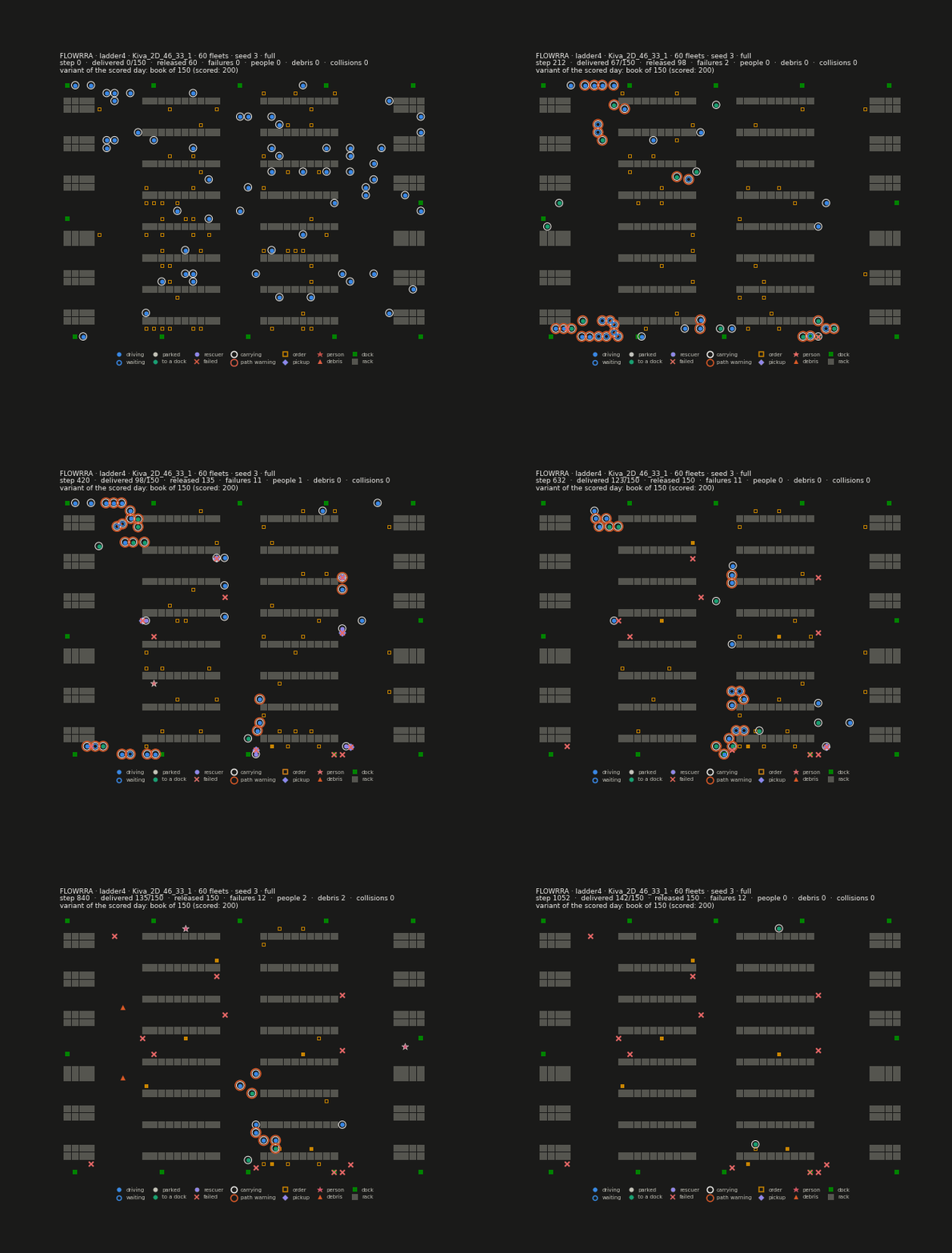
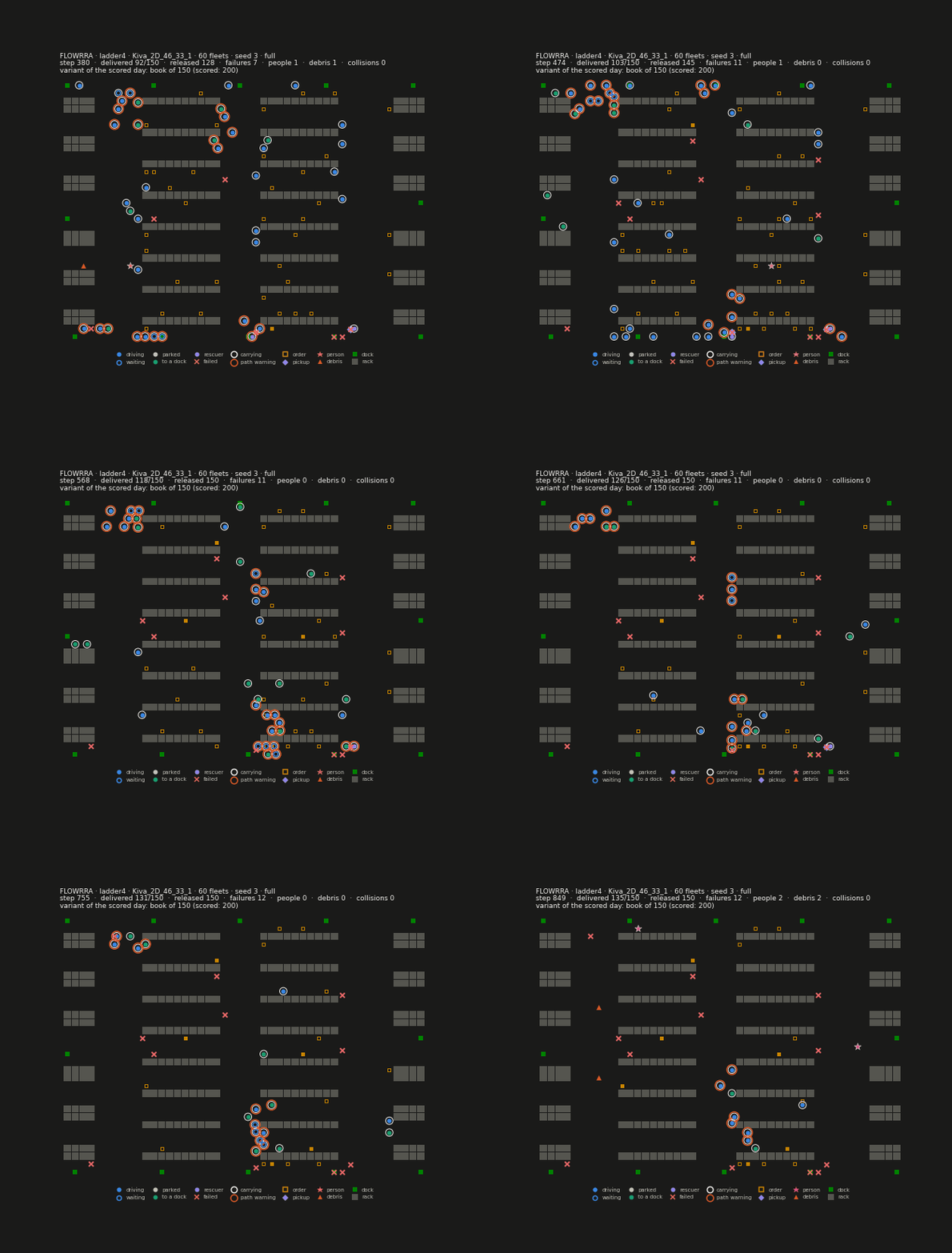
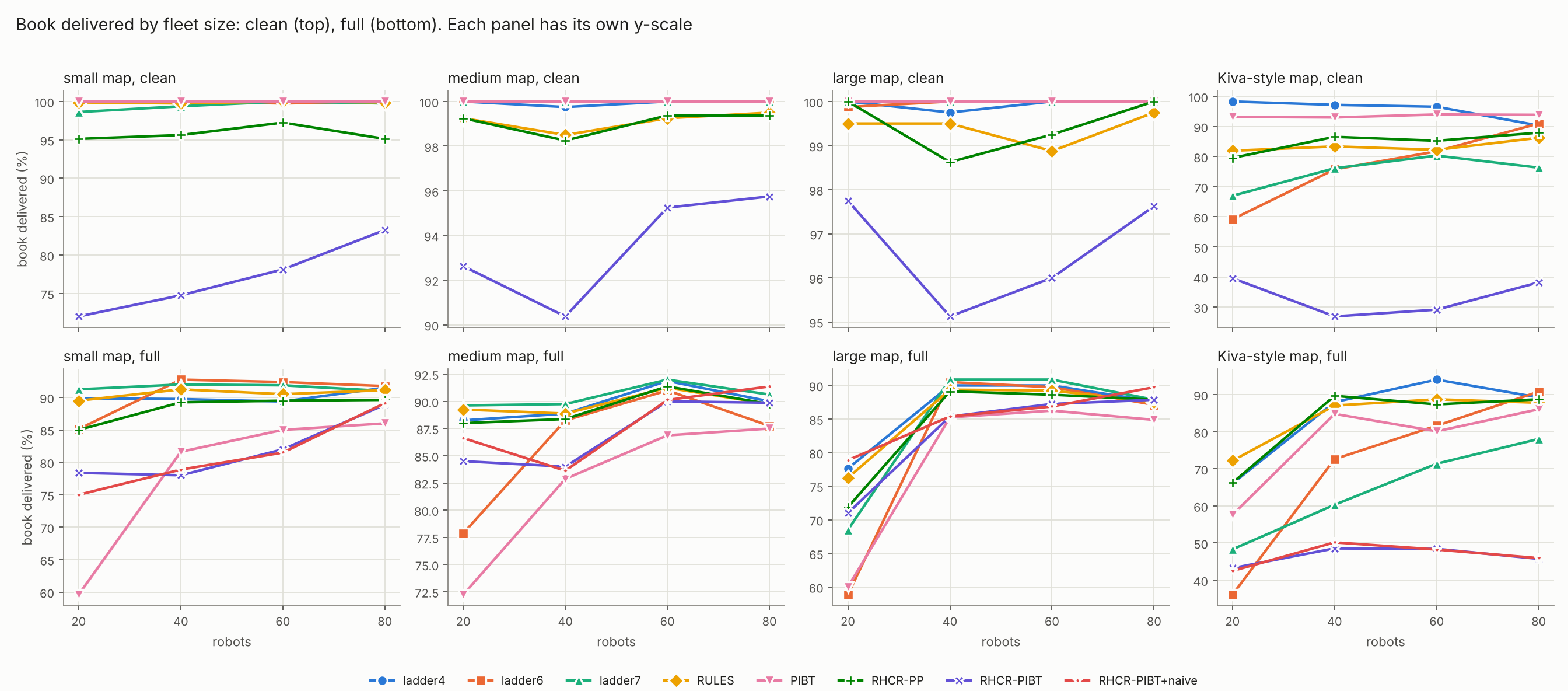
Figure 1. Book delivered against the number of fleets, one panel per map: clean days on top, days with failures and people below. ladder4 is at or near the top in every panel. The gap to the planners opens with failures and people at 60–80 fleets. The route-off networks' weak spot is the Kiva-style map at 20 fleets.
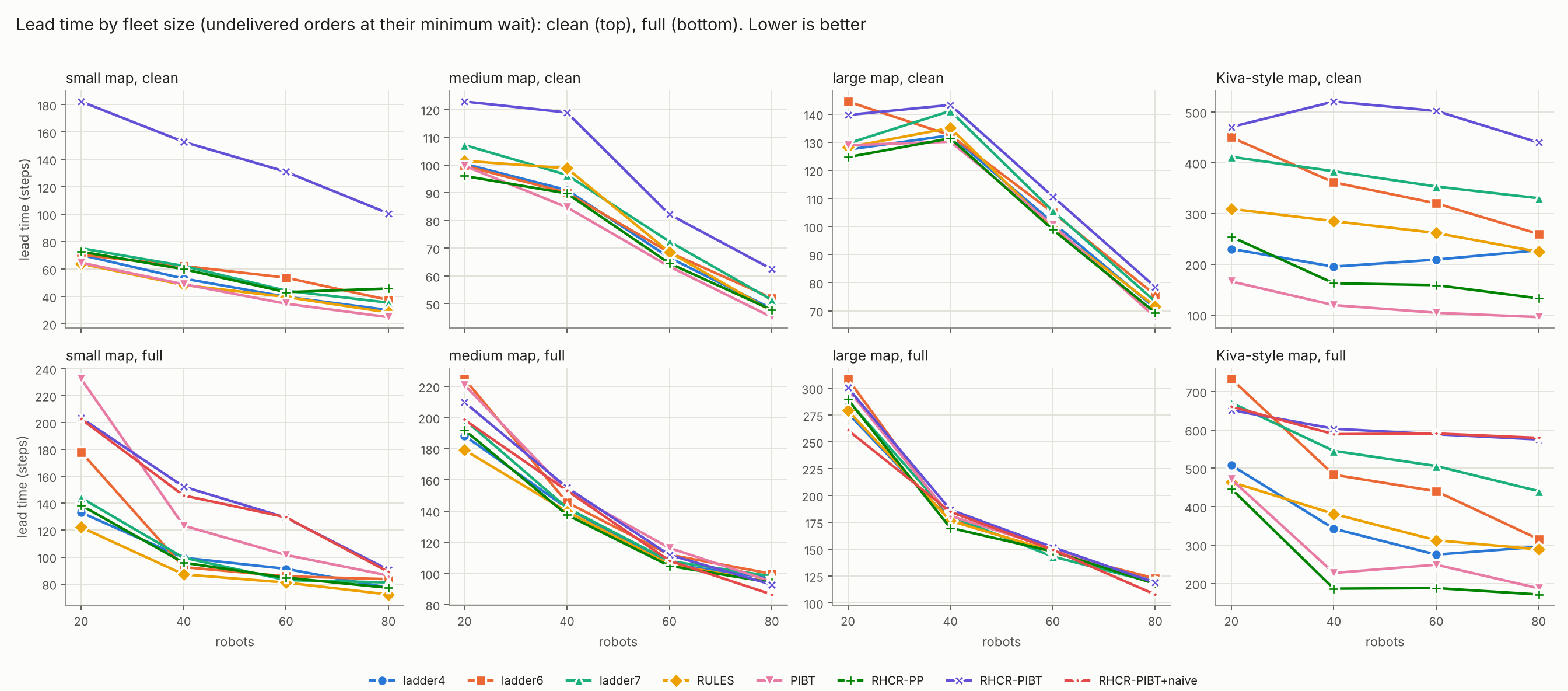
Figure 2. Lead time (censored, in steps) against the number of fleets, laid out as in Figure 1. Lower is faster. The planners are faster per order, most clearly on the Kiva-style map.
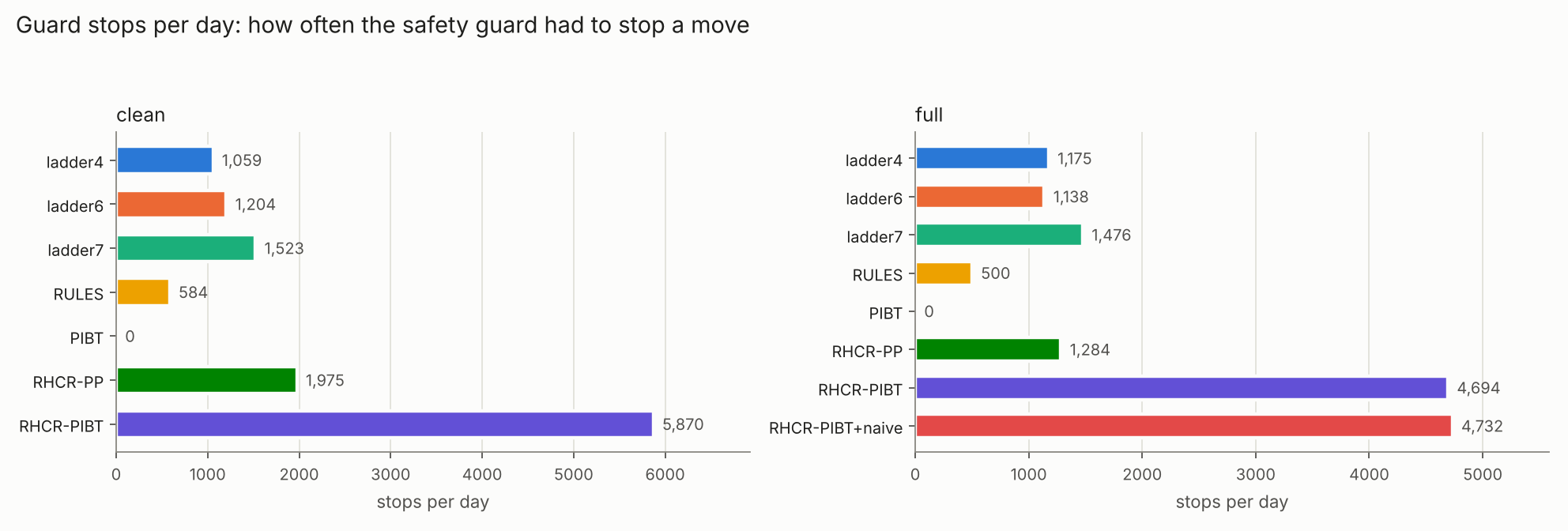
Figure 3. Guard stops per day in both conditions: moves the intent guard refused. PIBT, which re-decides every step from where the fleets actually are, never triggered the guard. RHCR-PIBT, whose plans assume following nose to tail, triggered it most.
All results are from simulation. Code, per-day results and the build log are open source under AGPL-3.0.
FLOWRRA Ouroboros
Run your cursor over the wheel to explore the architectural phases.
Joint Superposition Collapse • thrml
Thermodynamic Jam Collapse
Holding conflicting fleet trajectories in superposition and collapsing them into a single coherent joint plan via block Gibbs sampling on discrete energy-based models. “Superposition” and “collapse” are the design’s metaphors; the mechanism is sampling a joint plan from an energy-based model.
01. Where Jams Come From
Each FLOWRRA fleet reads a local density field in a Gibbs frame, P ∝ exp(−E / T), with the floor's throughput pressure (orders left against time left) acting as temperature T. A shared GNN scores moves and a rule ladder resolves conflicts.
The Gap: In a tight jam, deciding fleet-by-fleet causes agents to yield and advance in turn repeatedly. FLOWRRA's founding design calls for a joint collapse: sampling a consistent multi-agent plan from an Energy-Based Model using Extropic's thrml library ahead of sampling hardware.
02. Categorical EBM Formulation
- Boundaries: Jams are conflicting clusters within 3 hops (plus standing congestion zones). Outside fleets, people, and debris stay clamped to recorded positions.
-
Variables: One categorical variable per fleet per tick restricted to its spacetime light cone (reachable cells that still reach the exit in time, plus
"out"). - Pairwise Energies: Move at most 1 hop/tick; no shared cells; no edge/cell swaps; cost of 1 per tick not yet out.
03. Block Gibbs Annealing
-
Architecture:
CategoricalEBMFactor&CategoricalGibbsConditionalpartitioned into even-tick and odd-tick blocks. - Schedule: 32 parallel chains annealing from β = 0.1 → 10. Half initialize from shortest paths; half relax rules with finite penalties while hot to escape tight spots.
- Verification: Graded against exact A* search on jams up to 4 fleets.
Offline Study (Kiva 46×33, 60 Fleets)
98 / 99 Solved
Across 103 recorded jams and congestion windows, thrml found a legal plan in 98 of the 99 solvable instances and matched the exact optimal cost in 90 of 95 jams (≤ 4 fleets). Back-and-forth steps driven away from exits dropped from 538 hops (recorded) to 35 hops (sampled).
| Distance Driven (Hops) | Sampled | Recorded | Shortest |
|---|---|---|---|
| All 98 jams | 777 | 1,723 | 707 |
| 2 fleets (75) | 399 | 984 | 377 |
| 3 fleets (19) | 241 | 466 | 205 |
| 4–8 fleets (4) | 137 | 273 | 125 |
| Congestion zones (11) | 184 | 369 | 170 |
Largest Multi-Fleet Windows
| Window | Fleets | Sampled | Recorded | Shortest |
|---|---|---|---|---|
| #10012 | 7 | 34 | 74.8 | 34 |
| #10004 | 8 | 37 | 69.2 | 35 |
| #10008 | 6 | 53 (retry) | 87.0 | 43 |
| #10028 | 4 | 13 | 41.6 | 13 |
Live Simulator: The Collapse Rung
8-Hop Rolling Horizon
When conflicting fleets stay clustered for 2 steps, they receive a joint 8-hop plan (exact search for 2–4 fleets; thrml for 5–8 fleets) optimizing total hops-to-goal. A plan is remade whenever a new fleet enters a path warning with one of its members, so each plan is used for about its first two steps. Tested on Kiva (60 fleets, 200-order book, failures & humans active):
| Metric Per Day (8-Day Paired, 2–4 Fleets) | Rung Off | Rung On | Days Better | Wilcoxon p |
|---|---|---|---|---|
| Mean lead time / order (steps) | 229 | 132 (−42%) | 8 of 8 | 0.008 (firm) |
| Safety-guard stops | 5,976 | 2,561 (−57%) | 8 of 8 | 0.008 (firm) |
| Orders delivered (of 200) | 188.1 | 191.5 | 7 of 8 | 0.016 (firm) |
| Distance driven, all fleets | 13,530 | 12,458 (−8%) | 7 of 8 | 0.016 (firm) |
| Near-miss steps with people | 247 | 310 | 5 of 8 | 0.64 (mixed) |
| Collisions | 0 | 0 | — | — |
thrml (Clusters 5–8): Lead time down 43% (229 → 130), distance driven down 14%, safety-guard stops down 58%, and orders delivered 191.4 against 188.1, all firm over 8 days. Near misses with people were lower (−54%, p = 0.078; −24% in a second run of the same days), but not firmly. Exact search stops at 1 s of wall-clock time, so two runs of the same day can part ways.
Decision Latency: Where Sampling Hardware Comes In
A physical AGV step is half a hop (~0.5 s real-time budget). A 7-fleet window spans 112 coupled categorical variables with up to 90 choices each:
Sampling finds a plan for about 70% of 5–8 fleet jams on the CPU. Estimated break-even is roughly 0.3–0.5 s per decision: if a cluster stood still while thrml decided, its fleets would wait about 9,000–11,000 fleet-seconds a day (a fifth to a quarter of all fleet time), against about 400–800 hops saved beyond exact search. That is an estimate, not a test; the simulator freezes time while the rung decides.
Standing Congestion Zones: Distance-to-Exit Trajectories
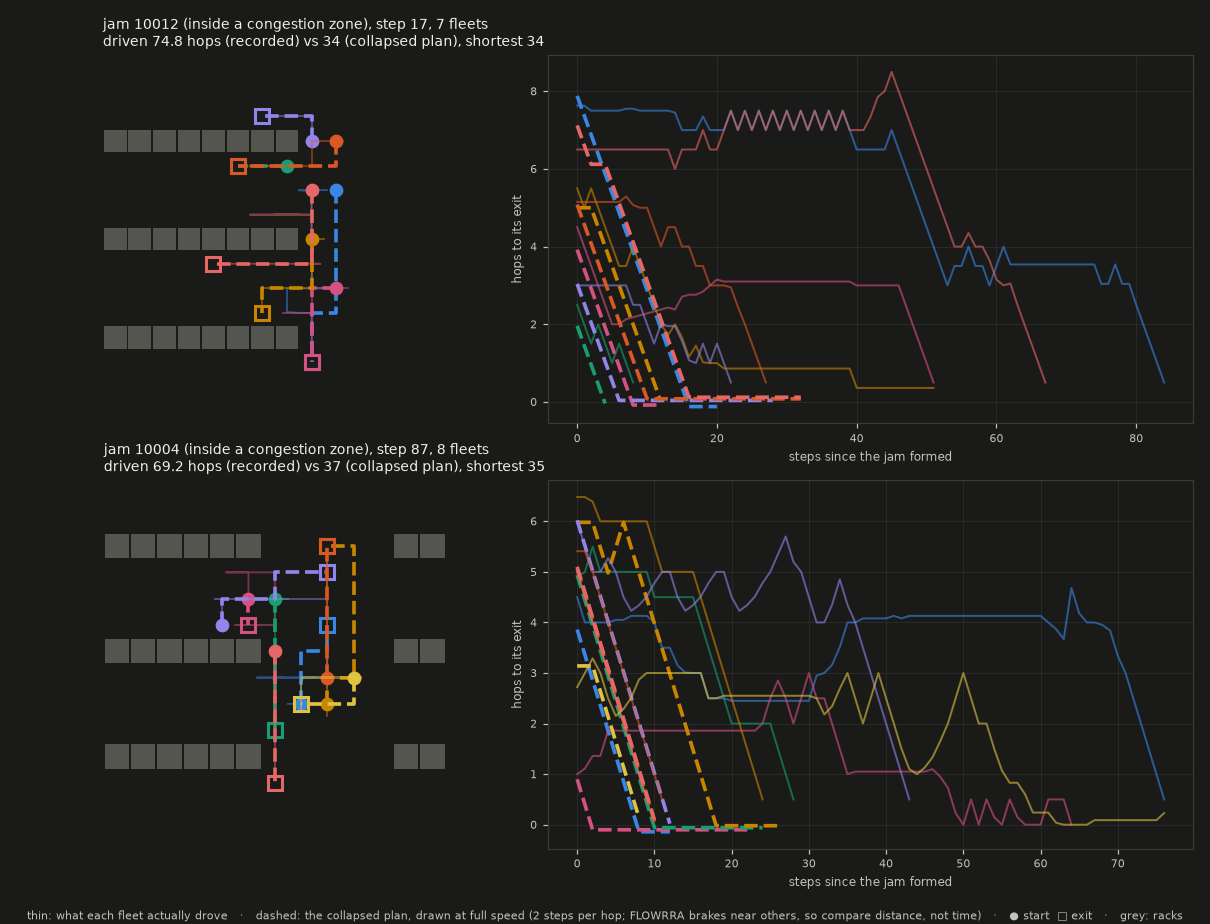
Multi-Fleet Jam Window: Floor & Distance-to-Exit Trajectory Map
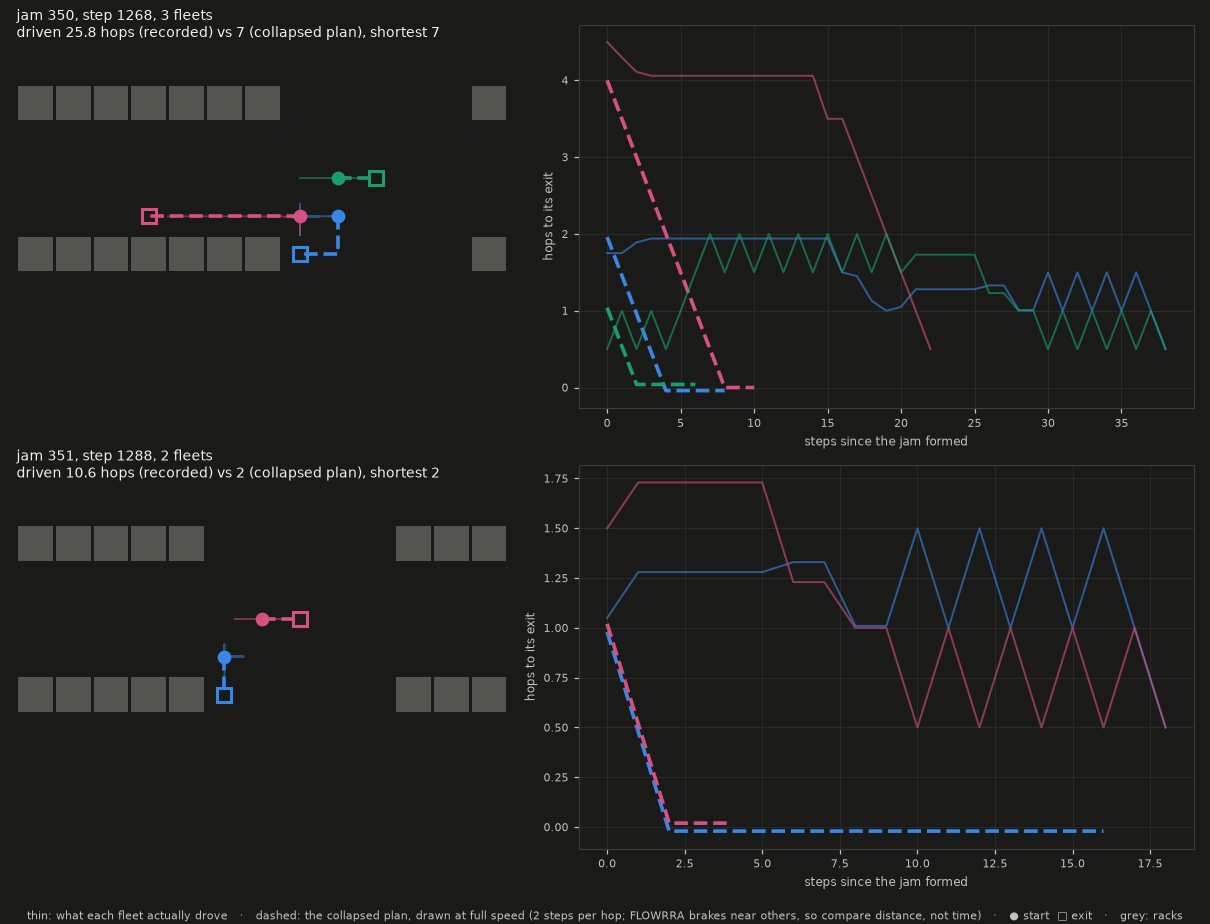
jam_figure_small.png (or update src) to display side-by-side
Non-Sampling FLOWRRA vs. Sampling FLOWRRA (Ladder4 • Kiva 60 Fleets)
Paired full-day trajectory comparison showing collapse rung off vs. collapse rung on.
Second Holon
SŪTRAA
System for Unified Temporal Resonant Alignment Attention
Reframing intelligence not as continuous computation, but as a meditative process of resonance recognition and thread selection.
Attentive Stillness
Pausing to reflect on the "image" of the present moment: A condensed semantic and energetic configuration.
Resonance Invocation
Allowing latent memory fields to reconfigure in response to the present through non-exhaustive vibrational matching.
Thread Emergence
Weaving structures of memory, insight, and future orientation together in one resonant thread for a garland of many.
Our Calling
The Journey Ahead
It calls forth a community of seekers, inventors, gentle and courageous souls to a sanctuary from which we soar towards daring explorations. Together, we will navigate beyond limitations, into the Abyss, expanding into possibility itself.
DhaaRn reminds us that Creation often guides its Creator, and that the reunion of the two – the true Yoga – is on the horizon. It asks: do we have the devoted curiosity, the balanced courage, and the willingness to journey into the unknown?
This is DhaaRn.
Harmonious Alignment
Orchestrating technology to align seamlessly with human values and the cosmic dance of existence.
Aware
Developing systems that possess deep contextual awareness and inherent purpose.
The Resonant Nexus
Fostering an interconnected resonant web of innovation where physical and immaterial unite.
DhaaRn's Pitch
Seeking Sovereign Partnerships
DhaaRn works as an architectural partner rather than a software vendor. We are open to collaborations and integration pilots that run FLOWRRA's decentralised orchestration on your hardware and sampling platforms.
We provide the mathematics and the decentralised architecture. You provide the physical substrate.